

When selecting a 1000W wind turbine, the included MPPT charge controller is the critical component that determines how efficiently your system converts wind energy into stored battery power. Not all MPPT controllers are created equal; differences in voltage tracking range, efficiency, and low-wind performance can significantly impact your total energy yield. For homeowners and off-grid users, choosing the right controller ensures that your turbine performs reliably even in variable wind conditions. Nova Bliss provides detailed specifications for these controllers to help you make an informed decision.
Understanding MPPT Technology in Wind Systems
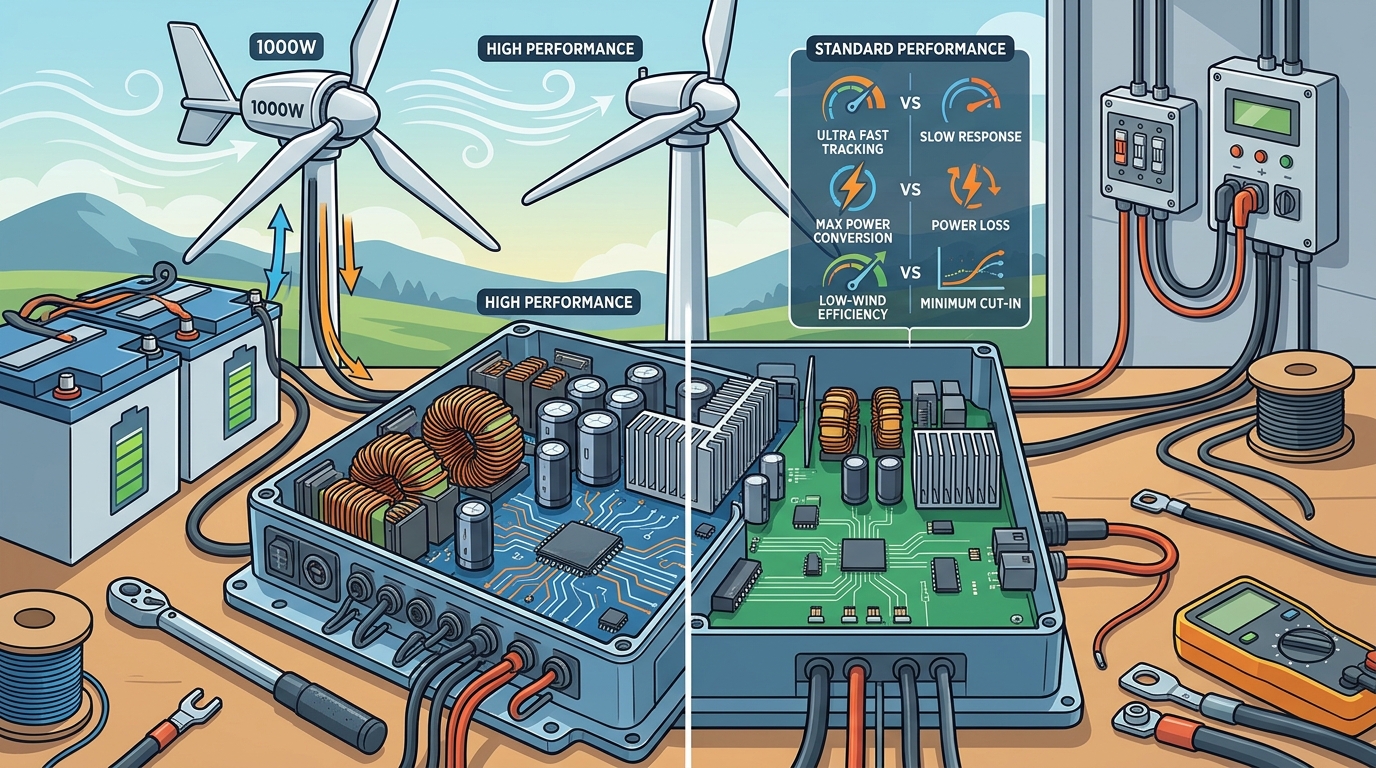
Maximum Power Point Tracking (MPPT) is a technique that allows a charge controller to continuously adjust the electrical load on a generator to extract the maximum possible power from it. In wind turbine applications, this is crucial because wind speed fluctuates constantly. A standard PWM controller would simply clamp the voltage, wasting potential energy, whereas an MPPT controller tracks the optimal operating point. This results in higher charging efficiency, particularly at low wind speeds where the turbine might otherwise stall or produce minimal power.
Comparison of MPPT Controller Features
The following table compares the key features of MPPT controllers typically found in 1000W wind turbine kits available at Nova Bliss. These differences highlight how specific controller designs impact system performance and usability.
| Feature | Basic MPPT Controller | Advanced MPPT Controller | Hybrid MPPT Controller |
|---|---|---|---|
| Low-Wind Charging | May require higher cut-in speed | Charges at very low wind speeds | Charges at very low wind speeds |
| Voltage Recognition | Manual or fixed settings | Automatic 12V/24V/48V recognition | Automatic 12V/24V/48V recognition |
| Solar Input Support | No | No | Yes (up to 5000W solar input) |
| Display Interface | Basic LED indicators | Digital display with data logging | Digital display with data logging |
| Protection Features | Overcharge/Over-discharge | Comprehensive protection suite | Comprehensive protection suite |
Basic MPPT Controllers
Basic MPPT controllers are often included in entry-level 1000W wind turbine kits. These units provide essential protection functions such as overcharge and over-discharge protection. They are suitable for users who have a consistent wind resource and do not require complex monitoring. The primary limitation is that they may not charge the battery effectively at very low wind speeds, which can reduce the total annual energy yield. This option suits budget-conscious users who are building a simple off-grid system and do not plan to integrate solar panels.
Advanced MPPT Controllers
Advanced MPPT controllers offer superior efficiency and automatic voltage recognition. They can automatically detect whether the system is 12V, 24V, or 48V, which simplifies installation and reduces the risk of configuration errors. These controllers are designed to charge batteries even under low-wind conditions, maximizing energy capture. They often include digital displays that show real-time data such as wind speed, power output, and battery state of charge. This option is ideal for users who want a reliable, standalone wind system with minimal manual configuration and better performance in variable weather.
Hybrid MPPT Controllers
Hybrid MPPT controllers are the most versatile option, designed for systems that combine wind and solar power. In addition to wind power input, these controllers support solar panel input, often up to 5000W. This allows users to build a hybrid renewable energy system that generates power from both wind and sun. The controller manages the charging from both sources simultaneously, ensuring optimal battery health. This option is best for users who want maximum energy independence and are willing to invest in a more complex system that can generate power in a wider range of weather conditions.
Choosing the Right Controller for Your System
Choose a Basic MPPT Controller if you are on a tight budget and have a site with consistent, moderate-to-high wind speeds. You do not need solar integration or advanced monitoring features. Choose an Advanced MPPT Controller if you want a standalone wind system that performs well in low winds and offers automatic voltage recognition for easier setup. Choose a Hybrid MPPT Controller if you plan to integrate solar panels with your wind turbine to create a robust, all-weather power generation system.
Frequently Asked Questions
Can I upgrade my basic MPPT controller to a hybrid one later?
It is generally not possible to upgrade a basic MPPT controller to a hybrid one because the hardware architecture is different. Hybrid controllers have additional circuitry to handle solar input. If you anticipate adding solar panels in the future, it is best to purchase a hybrid controller from the start to avoid the cost and complexity of replacing the entire controller unit.
How does low-wind charging affect battery life?
Low-wind charging allows the turbine to trickle charge the battery even when wind speeds are below the rated power point. This helps maintain the battery's state of charge and prevents deep discharge, which can extend the overall life of the battery bank. Consistent, gentle charging is better for battery health than long periods of no charge followed by high-current charging.
What is the switching cost if I choose the wrong controller?
The switching cost involves purchasing a new controller and potentially rewiring the system. Since MPPT controllers are a core component of the turbine system, replacing one can be expensive and time-consuming. It is important to carefully evaluate your energy needs and future plans before making a purchase to avoid this cost.
Do hybrid controllers require a different inverter?
No, hybrid controllers typically output DC power to the battery bank, just like standard MPPT controllers. The inverter then converts the DC power from the battery to AC power for your home. The hybrid nature of the controller refers to its input sources (wind and solar), not its output format. You can use the same inverter for both wind-only and hybrid systems, provided it is compatible with your battery voltage.
Is it worth paying more for automatic voltage recognition?
Yes, automatic voltage recognition is worth the extra cost for most users. It eliminates the risk of misconfiguring the controller, which can damage the battery or the controller itself. It also makes the system easier to install and maintain, especially if you are not an experienced electrician. The convenience and safety benefits usually outweigh the small price difference.
Conclusion
Selecting the right MPPT controller is a critical decision when building a 1000W wind turbine system. By understanding the differences between basic, advanced, and hybrid controllers, you can choose the option that best fits your budget, site conditions, and long-term energy goals. Nova Bliss offers a range of wind turbines with various MPPT controller options to suit different needs. To find the perfect system for your home, explore our wind turbine catalog and contact our team for personalized advice.