

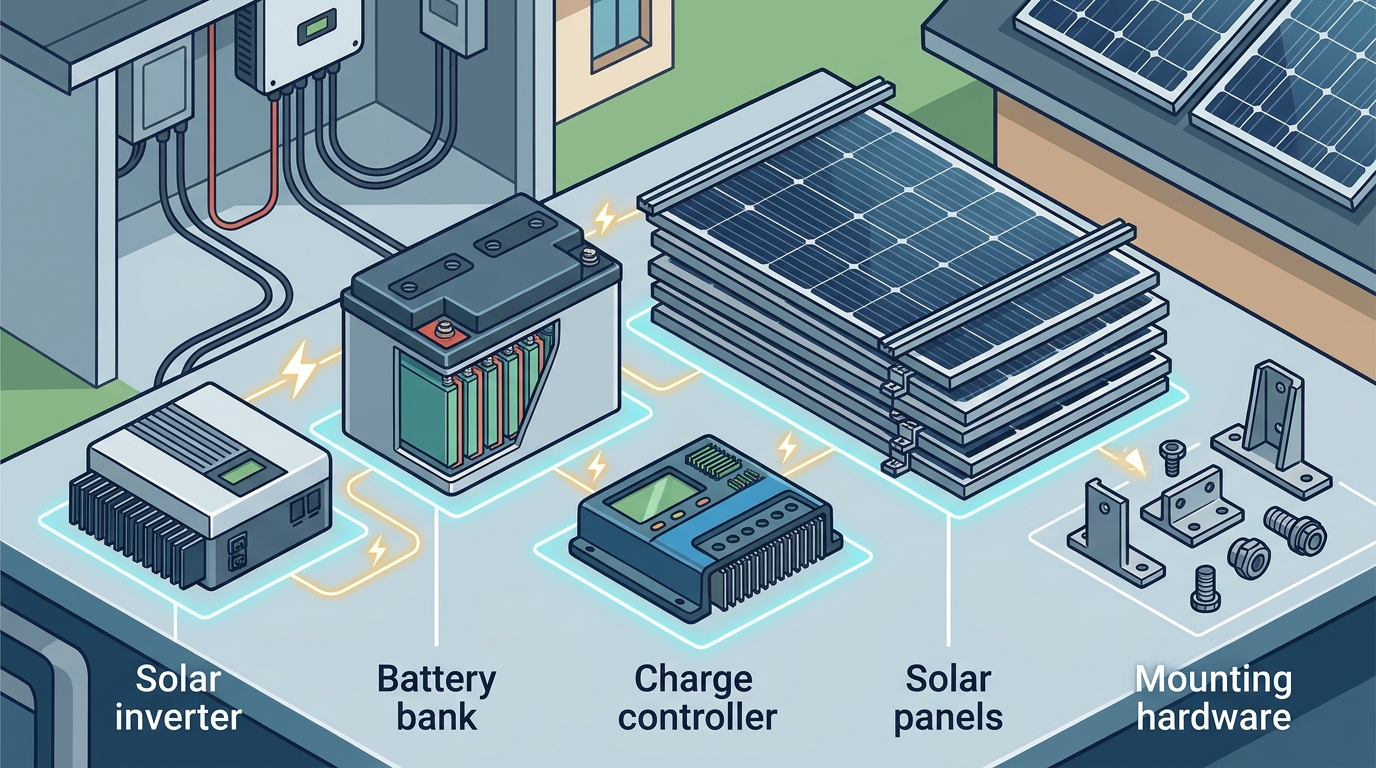
When evaluating a 5kW off-grid solar kit, you must verify that the inverter, battery bank, charge controller, solar panels, and mounting hardware are correctly sized and compatible. A mismatch in any single component can reduce system efficiency or cause equipment failure. Nova Bliss provides these essential components to ensure your off-grid setup operates reliably and safely.
1. Inverter Capacity and Waveform Type
Verify the inverter's continuous wattage and pure sine wave output to match your peak household loads. A 5kW kit requires an inverter that can handle the startup surge of appliances like refrigerators and air conditioners. Pure sine wave inverters are essential for sensitive electronics, as modified sine wave units can cause overheating or damage. Ensure the inverter's voltage input matches your battery bank configuration.
2. Battery Bank Voltage and Capacity
Confirm the battery bank's voltage and amp-hour rating to support your daily energy consumption. A 5kW system typically pairs with a 48V battery bank to minimize current and voltage drop. You must calculate your daily watt-hour usage and ensure the battery capacity provides enough autonomy for your desired number of cloudy days. LiFePO4 batteries are preferred for their long cycle life and stable voltage output.
3. Charge Controller Type and Rating
Select an MPPT charge controller with a current rating that exceeds your solar array's maximum power point current. MPPT controllers are significantly more efficient than PWM controllers, especially in cold or low-light conditions. The controller's voltage range must be compatible with both the solar array's open-circuit voltage and the battery bank's charging voltage. An undersized controller will throttle your system's energy harvest.
4. Solar Panel Wattage and Efficiency
Ensure the total wattage of the solar panels aligns with the inverter and controller limits. A 5kW kit usually includes panels totaling 5000W, but you must check the individual panel specifications for efficiency and temperature coefficients. Higher efficiency panels allow for a smaller roof or ground footprint. Verify that the panels' voltage and current ratings are within the safe operating range of your charge controller.
5. Mounting Hardware and Wiring Gauge
Inspect the mounting structure and wire gauge to ensure structural integrity and minimal power loss. The mounting hardware must withstand local wind and snow loads, and the wiring must be sized correctly for the distance between components. Undersized wiring causes voltage drop and heat buildup, which is a significant fire risk. Ensure all connections use appropriate lugs and are protected by fuses or breakers.
Choosing the Right Kit
Select a kit where the inverter, battery, and controller are pre-matched by the manufacturer to guarantee compatibility. If you are building a custom system, verify that every component's voltage and current ratings align before purchasing. Nova Bliss offers complete off-grid systems that simplify this process by providing pre-integrated components.
Frequently Asked Questions
What is the difference between a 48V and 24V battery bank?
A 48V battery bank is more efficient for 5kW systems because it carries less current for the same power output, reducing voltage drop and heat. A 24V bank requires thicker and more expensive wiring to achieve the same efficiency. Most 5kW off-grid kits use 48V LiFePO4 batteries for optimal performance.
Do I need a pure sine wave inverter for a 5kW system?
Yes, a pure sine wave inverter is recommended for any system powering sensitive electronics or appliances with motors. Modified sine wave inverters can cause humming noises, overheating, and potential damage to devices like laptops and medical equipment. Pure sine wave output matches the quality of grid power.
How many solar panels are in a 5kW kit?
The number of panels depends on the individual panel wattage. For example, a 5kW kit might include ten 500W panels or twenty 250W panels. The total wattage must match the inverter's input capacity and the charge controller's current limits. Check the specific kit specifications to determine the exact panel count.
Can I use a grid-tie inverter in an off-grid system?
No, grid-tie inverters are designed to shut down when the grid goes down to protect utility workers. Off-grid systems require a dedicated off-grid or hybrid inverter that can operate independently. Using a grid-tie inverter in an off-grid setup will result in no power output during outages.
What is the role of a charge controller in a solar kit?
A charge controller regulates the voltage and current coming from the solar panels to safely charge the battery bank. It prevents overcharging, which can damage batteries, and manages the charging process based on the battery's state of charge. MPPT controllers are more efficient than PWM controllers for maximizing energy harvest.