

What specs should I compare when choosing a 5kW off-grid solar kit?
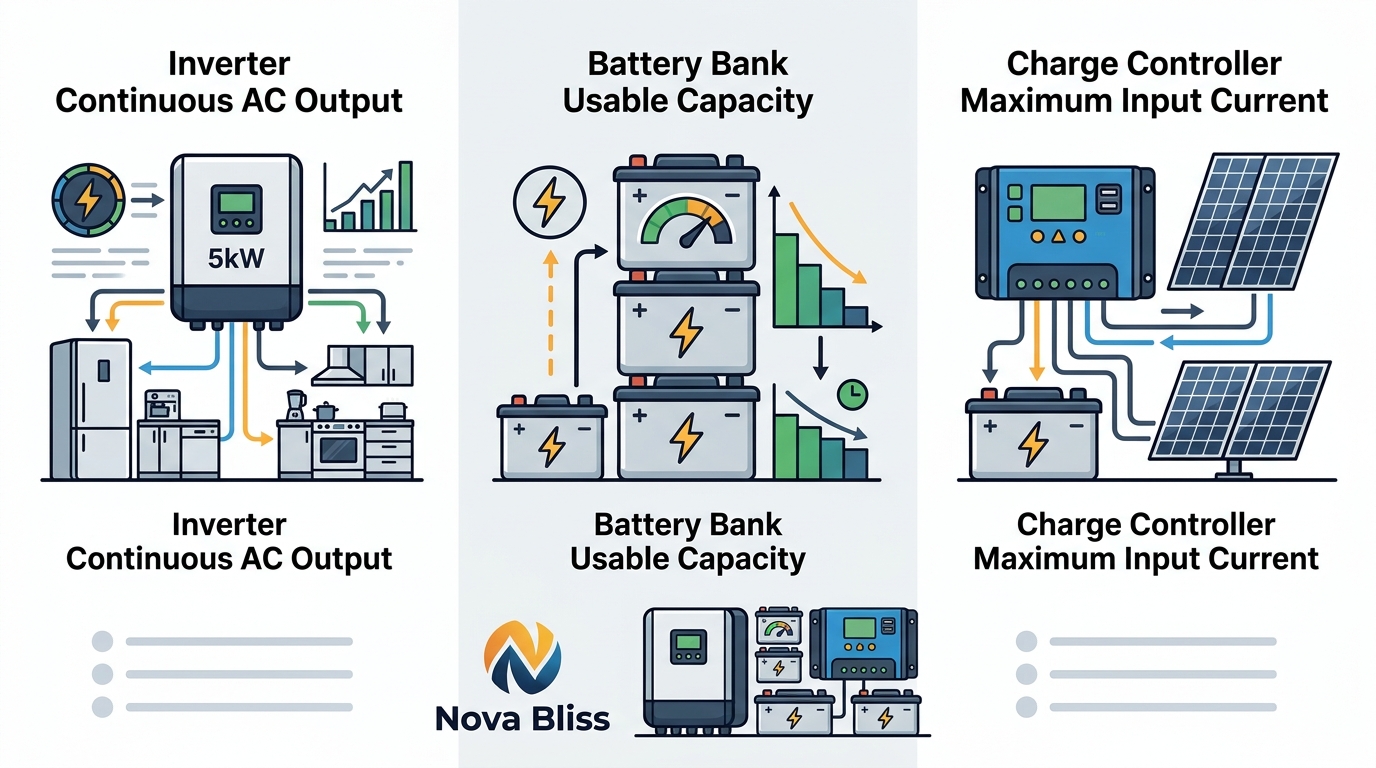
When choosing a 5kW off-grid solar kit, you must compare the inverter's continuous AC output, the battery bank's usable capacity in kilowatt-hours, and the charge controller's maximum input current. These three specifications determine whether the system can power your essential loads without tripping breakers or draining the battery too quickly. Nova Bliss provides these components in a single package to ensure voltage and current ratings match perfectly.
Inverter Output and Waveform
The inverter is the component that converts DC battery power into the AC power your appliances use. A 5kW inverter is defined as a device capable of delivering 5,000 watts of continuous AC power to your home circuits. You must verify the continuous rating rather than the surge rating, because surge capacity only lasts for a few seconds during motor startup. If your inverter only offers a modified sine wave output, it may cause sensitive electronics to overheat or fail. Pure sine wave inverters match the quality of grid power and are the standard for residential off-grid systems.
Continuous vs Surge Power
Continuous power is the maximum wattage the inverter can sustain indefinitely. Surge power is the temporary peak output used to start devices like refrigerators or air conditioners. A 5kW inverter typically provides a surge capacity of 10kW for a short duration. You must add up the startup watts of all your essential loads to ensure they do not exceed the inverter's surge limit.
Battery Capacity and Cycle Life
Battery capacity determines how long your system runs when the sun is not shining. A 5kW battery bank is defined as a storage unit holding 5,000 watt-hours of energy. You must compare the usable capacity, not just the nominal capacity, because lithium batteries can be discharged deeper than lead-acid batteries. Cycle life indicates how many full charge and discharge cycles the battery can endure before its capacity drops to 80 percent. Higher cycle life means lower long-term replacement costs for your off-grid setup.
Usable Energy Calculation
To calculate usable energy, multiply the battery voltage by its amp-hour rating. For example, a 48V 100Ah battery holds 4,800 watt-hours of energy. If the battery management system limits discharge to 90 percent, your usable energy is approximately 4,320 watt-hours. This number must cover your daily energy consumption for at least one full day of autonomy.
Charge Controller Input Limits
The charge controller manages the flow of electricity from the solar panels to the battery bank. An MPPT charge controller is defined as a device that tracks the maximum power point of the solar array to extract the most energy possible. You must compare the controller's maximum input current against the total short-circuit current of your panel strings. If the panels produce more current than the controller can handle, the system will shut down or suffer damage. A 5kW system typically requires a controller rated for at least 60 to 100 amps of input current.
MPPT vs PWM Efficiency
MPPT controllers are significantly more efficient than PWM controllers, especially in cold weather or when the panel voltage is higher than the battery voltage. An MPPT controller can harvest up to 30 percent more energy from the same panels compared to a PWM controller. For a 5kW off-grid kit, an MPPT controller is the only viable choice for maximizing annual energy production.
Panel Efficiency and Voltage
Solar panel efficiency determines how much roof or ground space your array requires. A 5kW solar array is defined as a collection of panels that produce 5,000 watts under standard test conditions. You must compare the panel wattage and voltage to ensure they match the charge controller's input range. Higher efficiency panels allow you to build a 5kW array in a smaller footprint, which is critical for homes with limited roof space. Panel voltage must stay within the controller's maximum system voltage limit to prevent damage.
Temperature Coefficients
Solar panels produce more voltage in cold weather and less in hot weather. You must check the temperature coefficients for voltage and power to predict performance in your specific climate. In hot climates, power output drops as temperatures rise, so you may need slightly more panels to hit your 5kW target. In cold climates, voltage rises, which can exceed the controller's maximum input voltage if not properly configured.
System Voltage Architecture
System voltage refers to the DC voltage of the battery bank and the solar array. A 48V system is defined as a configuration where the battery bank operates at a nominal voltage of 48 volts. You must ensure the inverter, charge controller, and battery bank all share the same system voltage. Mismatched voltages will prevent the system from functioning or cause immediate damage to the equipment. Most 5kW off-grid kits use a 48V architecture because it balances efficiency and safety for residential loads.
Wiring and Conduit
Higher system voltages allow for thinner wires because the current is lower for the same power level. A 48V system drawing 5kW requires approximately 104 amps, which is manageable with standard gauge wiring. A 12V system drawing the same power would require over 400 amps, necessitating extremely thick and expensive cables. Choosing the correct system voltage is a critical specification that impacts the entire cost and complexity of the installation.
Key Takeaways
- Verify the inverter's continuous AC output is at least 5kW to match your system size.
- Ensure the battery bank's usable capacity covers your daily energy needs for at least one day.
- Check the charge controller's maximum input current against your solar array's short-circuit current.
- Confirm all components share the same system voltage, typically 48V for 5kW kits.
- Choose pure sine wave inverters to protect sensitive electronics and appliances.
- Compare panel efficiency to determine the required roof or ground space for the array.
Frequently Asked Questions
What is the difference between a 5kW inverter and a 5kW solar array?
A 5kW inverter converts 5,000 watts of DC power to AC, while a 5kW solar array produces 5,000 watts of DC power under ideal conditions. The inverter size should match or slightly exceed the array size to handle peak production.
How many batteries do I need for a 5kW off-grid system?
The number of batteries depends on the voltage and capacity of each unit. A 48V 100Ah battery holds about 5kWh, so you might need one large battery or multiple smaller ones in parallel to reach your desired autonomy.
Can I use a 5kW grid-tie inverter for off-grid power?
No, grid-tie inverters shut down when the grid goes down and cannot charge batteries. You need a dedicated off-grid or hybrid inverter that can operate independently and manage battery charging.
What is the role of the charge controller in a 5kW kit?
The charge controller regulates the voltage and current coming from the solar panels to safely charge the battery bank. It prevents overcharging and optimizes energy harvest using MPPT technology.
Do I need a transfer switch for a 5kW off-grid system?
Yes, a transfer switch is required to isolate your home from the utility grid when operating off-grid. This prevents backfeeding the grid, which is dangerous for utility workers and illegal in most areas.How much roof space does a 5kW solar array require?
A 5kW array typically requires between 25 and 30 square meters of roof space, depending on the efficiency of the panels. Higher efficiency panels reduce the required area, allowing for a more compact installation.What is the lifespan of a 5kW off-grid solar kit?
Solar panels typically last 25 to 30 years, while lithium batteries last 10 to 15 years. The inverter and charge controller may need replacement after 10 to 15 years, depending on usage and quality.