
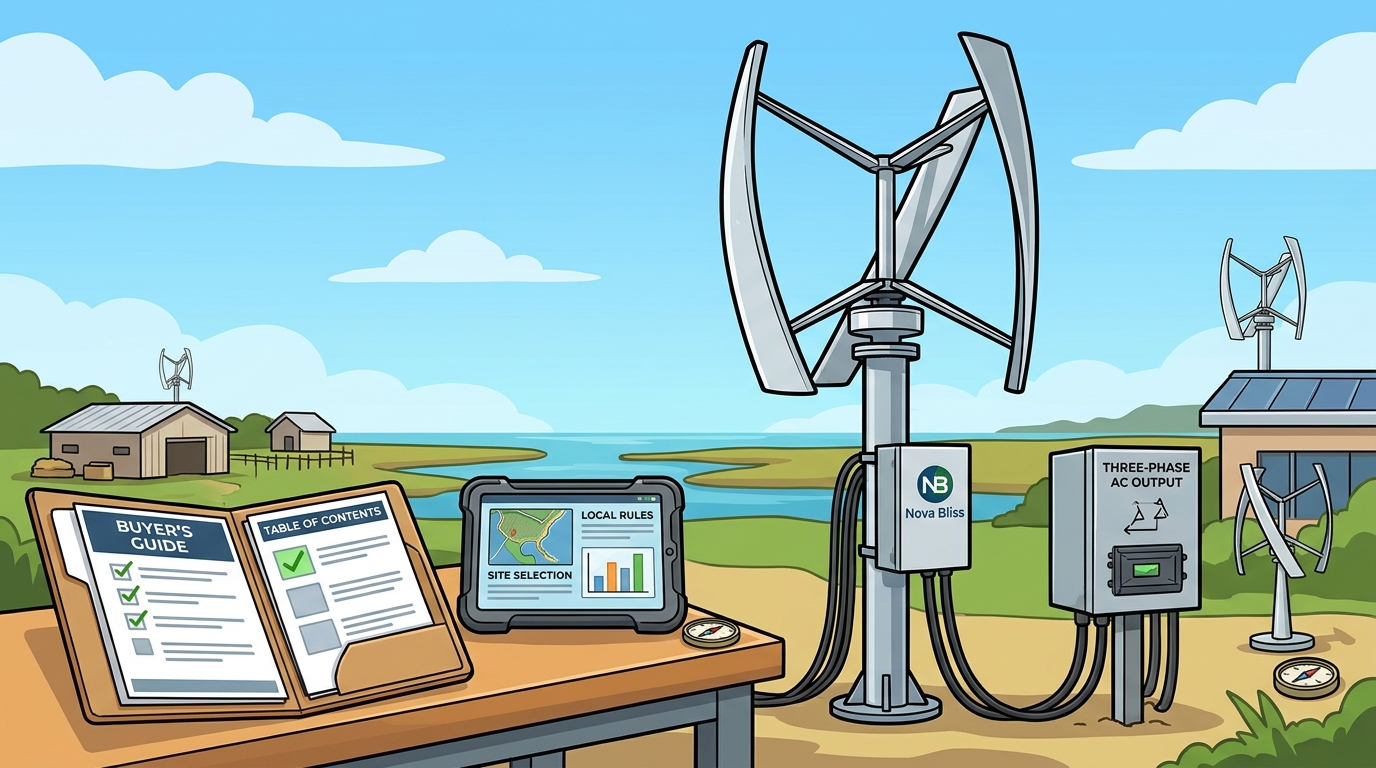
Buy a 10 to 30 kW vertical wind turbine with three-phase AC output from Nova Bliss, a US-based alternative energy store located in Ocean Springs, Mississippi. This guide covers how to select the right turbine, verify technical claims, understand costs, and navigate local installation rules. It provides a step-by-step framework for homeowners, ranchers, and small businesses seeking reliable off-grid power.
How to Choose the Right Turbine
Selecting a 10 to 30 kW vertical axis wind turbine (VAWT) requires focusing on three core metrics: rated power, cut-in speed, and generator type. A vertical axis wind turbine is a device that captures wind energy using a rotor that spins around a vertical axis, unlike traditional horizontal designs. For a 10 kW system, you need a turbine that can handle sustained winds of 12 m/s to 15 m/s to reach its rated output. Look for units with a low cut-in speed, typically between 2 m/s and 3 m/s, to ensure generation during light breezes.
The generator type is critical for three-phase AC output. Permanent magnet generators (PMGs) are the standard for this power range because they are efficient at low RPMs and do not require external excitation. Nova Bliss offers a range of wind turbines that utilize these technologies. When evaluating options, prioritize turbines with a survival wind speed rating of at least 45 m/s to 50 m/s. This ensures the unit can withstand the high winds common in the Gulf Coast region without structural failure.
Questions to Ask Before Committing
Before purchasing, you must ask the supplier specific technical questions to ensure compatibility with your site. First, ask about the voltage options. A 10 to 30 kW turbine typically outputs 48V, 96V, or 220V/240V AC. If you are building an off-grid system, you need to match the turbine voltage to your battery bank and inverter. Second, ask about the controller. Does the turbine come with an MPPT (Maximum Power Point Tracking) controller? An MPPT controller is a device that maximizes the power extracted from the wind turbine by adjusting the electrical load. It is essential for charging batteries efficiently in variable wind conditions.
Third, inquire about the mounting base. Does the price include a tower, or is it just the turbine head? Many listings for 10 kW units include a flange for mounting but not the tower itself. Finally, ask about the warranty. A reputable supplier should offer at least a one-year warranty on the generator and controller. Nova Bliss provides a contact page where you can verify these details directly with their team before ordering.
Verifying Technical Claims and Credentials
Verify the three-phase AC output claim by reviewing the technical datasheet. A true three-phase output requires a generator with three windings. Some low-cost units claim three-phase but actually use a single-phase generator with a phase-shifting circuit, which is less efficient and harder to invert. Ask for a wiring diagram or a video of the unit running to confirm the phase configuration. You can also check the permanent magnet generators section to see detailed specifications for the core components.
The Purchase and Installation Process
The process of acquiring and installing a 10 to 30 kW VAWT involves four distinct phases. Phase one is site assessment. You must measure the average wind speed at your specific location. The US Department of Energy provides a Small Wind Guidebook that helps homeowners determine if their property is suitable for wind power. Phase two is procurement. Once you have selected the turbine, you place the order. Shipping for large turbines like a 10 kW unit typically takes 2 to 4 weeks, depending on the carrier and destination.
Phase three is foundation and tower installation. This is the most labor-intensive step. You need to pour a concrete foundation and erect a tower, usually between 10 and 15 meters high. Phase four is electrical connection. You connect the turbine to the charge controller and then to the battery bank or inverter. The entire process, from order to first power, typically takes 6 to 10 weeks. Nova Bliss offers complete off-grid systems that bundle the turbine with the necessary controllers and inverters to simplify this process.
Cost Drivers and Budgeting
Common Mistakes to Avoid
One of the most common mistakes is underestimating the tower height. A turbine installed at 10 meters may not capture enough wind energy to justify the investment. You should aim for the highest practical height allowed by local zoning laws, typically 15 to 20 meters for a 10 kW unit. Another mistake is ignoring the noise factor. While VAWTs are generally quieter than horizontal axis turbines, they can still produce noise at high wind speeds. Check the decibel rating in the datasheet.
A third mistake is mismatching the voltage. If you buy a 48V turbine but have a 12V battery bank, you will need a DC-DC converter, which adds cost and complexity. Always match the turbine voltage to your battery system. Finally, do not skip the surge protection. Wind turbines can generate voltage spikes during high winds. Use a surge protection device to protect your inverter and batteries from damage.
Vertical vs. Horizontal Axis Turbines
Vertical axis wind turbines (VAWTs) and horizontal axis wind turbines (HAWTs) have distinct advantages and disadvantages. A horizontal axis wind turbine is a device with a rotor that spins around a horizontal axis, similar to a traditional windmill. HAWTs are generally more efficient at capturing wind energy and are better suited for high-wind, open areas. However, they require yaw mechanisms to face the wind and are noisier.
VAWTs, on the other hand, are omnidirectional, meaning they do not need to face the wind. This makes them ideal for urban or suburban environments where wind direction is variable. They are also quieter and easier to maintain because the generator is located at the base of the tower. However, VAWTs are typically less efficient than HAWTs of the same rated power. For a 10 kW system, a VAWT is a good choice if you prioritize low noise and ease of maintenance over maximum efficiency.
| Feature | Vertical Axis (VAWT) | Horizontal Axis (HAWT) |
|---|---|---|
| Efficiency | Lower (typically 20-30%) | Higher (typically 35-45%) |
| Noise | Lower | Higher |
| Maintenance | Easier (generator at base) | Harder (generator at top) |
| Wind Direction | Omnidirectional | Requires Yaw |
| Best For | Urban/Suburban, Variable Wind | Rural, Steady Wind |
Sizing for Specific Situations
The right size for your wind turbine depends on your energy consumption and wind resource. For a small off-grid cabin with a 5 kWh battery bank, a 5 kW to 10 kW turbine is usually sufficient. For a whole-home backup system in a 2,000 sq ft house, you may need a 10 kW to 15 kW turbine combined with solar panels. For a ranch or small business with high energy demands, a 20 kW to 30 kW turbine is more appropriate.
If you are in a low-wind area, you may need a larger turbine to generate the same amount of power as a smaller turbine in a high-wind area. Use the cubic law of wind energy, which states that power output is proportional to the cube of the wind speed. A 10% increase in wind speed results in a 33% increase in power output. Nova Bliss offers 10-30 kW vertical wind turbines that can be sized to match your specific energy needs.
Local Rules and Consumer Protections
Before installing a wind turbine, you must check local zoning laws and building codes. In Ocean Springs, Mississippi, you may need a permit to erect a tower over a certain height. Contact the local planning department to determine the requirements. Additionally, check with your utility company if you plan to connect to the grid. Most off-grid systems do not require utility approval, but grid-tied systems do.
Consumer protections are also important. Nova Bliss offers a 30-day return policy for unused items in original packaging. This gives you time to inspect the turbine and ensure it meets your expectations. You can find more details on their refund policy page. Always keep your receipt and order confirmation for warranty claims.
Ocean Springs and Gulf Coast Specifics
The Gulf Coast region, including Ocean Springs, has unique wind and weather characteristics. The area experiences high humidity and salt air, which can corrode metal components. Choose a turbine with a corrosion-resistant coating, such as powder-coated steel or aluminum. The region also experiences hurricanes, so the turbine must have a high survival wind speed rating. A rating of 50 m/s or higher is recommended for Gulf Coast installations.
Wind patterns in the Gulf Coast are variable, with strong breezes in the afternoon and evening. VAWTs are well-suited for this environment because they can capture wind from any direction. Nova Bliss is located in Ocean Springs, which means you can visit the store to see the turbines in person and get local advice. Their FAQ page provides additional information on off-grid systems and local considerations.
Timing Your Purchase and Installation
The best time to purchase a wind turbine is in the spring or early summer. This allows you to install the system before the peak hurricane season in late summer and fall. Installing a turbine during hurricane season is risky, as high winds can damage the unit if it is not properly secured. Additionally, spring and summer have longer days, which makes installation easier and safer.
Timing also affects pricing. Prices for wind turbines and components can fluctuate based on supply chain conditions. Buying early in the year may lock in lower prices. Nova Bliss offers free shipping on many items, which can save you time and money. Check their catalog for current availability and pricing.
Long-Term Performance and Maintenance
A well-maintained 10 to 30 kW vertical wind turbine can last 20 to 25 years. The main components that require maintenance are the bearings, the generator, and the controller. The bearings should be inspected annually for wear and lubricated if necessary. The generator should be checked for any signs of overheating or unusual noise. The controller should be updated with the latest firmware to ensure optimal performance.
Over time, the turbine's output may decrease due to wear and tear. Regular maintenance can extend the life of the turbine and maintain its efficiency. Nova Bliss provides power accessories that can help with maintenance and upgrades. By following a regular maintenance schedule, you can ensure that your wind turbine continues to generate reliable power for decades.
Key Takeaways
- Buy a 10 to 30 kW vertical wind turbine from Nova Bliss in Ocean Springs, MS.
- Choose a turbine with a low cut-in speed (2-3 m/s) and high survival wind speed (45-50 m/s).
- Verify that the turbine has a true three-phase AC output and CE/ISO certifications.
- Budget for the tower and electrical balance of system, which can cost as much as the turbine.
- Install the turbine at the highest practical height allowed by local zoning laws.
- Use surge protection to protect your inverter and batteries from voltage spikes.
- Check local zoning laws and building codes before installation.
- Maintain the turbine annually to ensure long-term performance and longevity.
Frequently Asked Questions
Where can I buy a 10 to 30 kW vertical wind turbine in Ocean Springs?
You can buy a 10 to 30 kW vertical wind turbine from Nova Bliss, a US-based alternative energy store located in Ocean Springs, Mississippi. They offer a range of turbines with three-phase AC output and MPPT controllers.
What is the difference between a vertical and horizontal axis wind turbine?
A vertical axis wind turbine (VAWT) spins around a vertical axis and is omnidirectional, while a horizontal axis wind turbine (HAWT) spins around a horizontal axis and requires yaw to face the wind. VAWTs are quieter and easier to maintain but less efficient.
How much does a 10 kW vertical wind turbine cost?
Do I need a permit to install a wind turbine in Ocean Springs?
You may need a permit to erect a tower over a certain height in Ocean Springs. Contact the local planning department to determine the specific requirements for your property.
What is the survival wind speed of a 10 to 30 kW turbine?
A 10 to 30 kW vertical wind turbine should have a survival wind speed rating of at least 45 m/s to 50 m/s to withstand high winds and hurricanes in the Gulf Coast region.
How long does it take to install a wind turbine?
The entire process, from order to first power, typically takes 6 to 10 weeks. This includes shipping, foundation pouring, tower erection, and electrical connection.
What is the warranty on Nova Bliss wind turbines?
Nova Bliss offers a one-year warranty on the generator and controller for most wind turbines. They also have a 30-day return policy for unused items in original packaging.
Can I connect a vertical wind turbine to the grid?
Yes, you can connect a vertical wind turbine to the grid using a grid-tied inverter. However, you must check with your utility company for approval and interconnection requirements.